




CASINO GUIDE
UK Casino Software, Payments and Bonus Rules Explained
 Available in GB
Understand the software, payment terms, bonus conditions and licensing rules behind the games available to UK players.

How UK Casino Software Shapes the Games You See
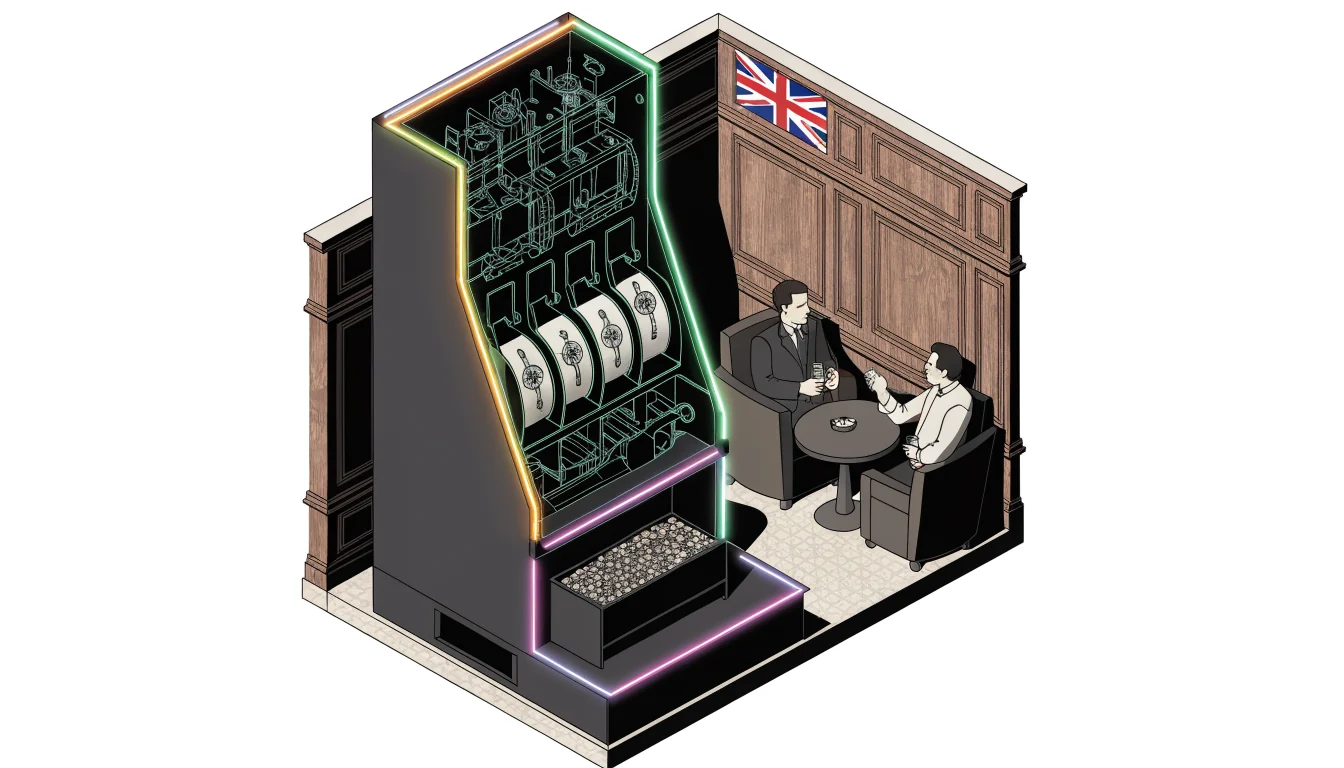
The game on your screen is the visible part of a larger technical chain. A casino operator provides the customer-facing website and account, but the game itself may be supplied by a separate game provider. Software connects these parts: it loads the game, records the session, applies the published rules, and returns the result to the operator’s platform.
This distinction matters because a casino is not necessarily the company that designed every game it offers. The operator is the licensed business serving customers in Great Britain. A game provider supplies software and content under a commercial arrangement. The platform may also rely on separate systems for account management, regulatory reporting, testing, and responsible-gambling controls.
The roles behind an online casino game
Several functions can exist even when the player sees one continuous website:
- The operator provides the gambling service to the customer and manages the account.
- The game provider creates or supplies the game software and associated content.
- The platform integrates games, accounts, records, and user-facing functions.
- Testing and technical systems help establish whether software behaves according to its defined rules.
- The regulator sets conditions that apply to the operator serving consumers in Great Britain.
This index provides a quick way to review UK operators by focusing on key practical details such as licensing, bonuses, payout times, and minimum deposits. Use the information to identify options that match your preferences before exploring further.
License: UKGC Operator Licence · Bonus: £100 bonus · Payout speed: Within 24 hours · Min. deposit: £10 Genesis Global Limited holds a UKGC Operator Licence and offers a £100 bonus. Its stated payout speed is within 24 hours, with a £10 minimum deposit.
License: UKGC Operator Licence · Bonus: £50 bonus · Payout speed: Within 48 hours · Min. deposit: £10 Platinum Gaming Limited is licensed by the UKGC and provides a £50 bonus. Payouts are stated as being completed within 48 hours, with a £10 minimum deposit.
License: UKGC Operator Licence · Bonus: £20 bonus · Payout speed: Within 48 hours · Min. deposit: £10 Silverbond Enterprises operates under a UKGC Operator Licence and offers a £20 bonus. Its stated payout speed is within 48 hours, and the minimum deposit is £10.
License: UKGC Operator Licence · Bonus: £100 bonus · Payout speed: Within 24 hours · Min. deposit: £10 LeoVegas holds a UKGC Operator Licence and offers a £100 bonus. It states payouts within 24 hours and requires a minimum deposit of £10.
License: UKGC Operator Licence · Bonus: £200 welcome bonus · Payout speed: Within 48 hours · Min. deposit: £10 32Red is licensed by the UKGC and offers a £200 welcome bonus. Payouts are stated as being completed within 48 hours, with a £10 minimum deposit.
License: UKGC Operator Licence · Bonus: £100 bonus · Payout speed: Within 24 hours · Min. deposit: £10 ProgressPlay Limited holds a UKGC Operator Licence and offers a £100 bonus. Its stated payout speed is within 24 hours, with a £10 minimum deposit.
These roles should not be treated as interchangeable. A provider can supply software to many operators, while each operator remains responsible for the gambling service it offers to its customers. The provider’s name may appear inside a game, in a help screen, or in technical information, but that does not by itself identify the licensed operator.
What casino software actually controls
Casino software is not just a graphical layer. It determines how the game is delivered and how a completed play is recorded. The interface displays the available actions and outcomes, while the underlying system handles the event that produces the result.
For a random game, the important mechanism is the random number generator. It produces the result according to the game’s programmed rules. The software then maps that result to the relevant outcome and updates the session record. The animation is a presentation of the result, not the mechanism that decides it. Stopping an animation early does not change an outcome that the system has already generated.
A complete software implementation also needs to manage interrupted sessions. If a connection fails after an action has been submitted, the platform must be able to identify the state of that play and display the appropriate result when the account is accessed again. This is one reason a casino game cannot be assessed solely by its appearance. The visible design is only one layer of the system.
The same principle applies to game information. Rules, available outcomes, and any stated return information need to correspond to the version being offered. A provider may update presentation, mathematics, or technical components, so the operator’s published information and the supplied software must remain aligned.
Why the operator still matters
A third-party game provider does not remove the operator’s regulatory responsibilities. Operators providing online gambling services to consumers in Great Britain must hold a UKGC licence, regardless of where the business is based. For online gambling activities, the relevant requirement is a remote operating licence.
Market United Kingdom
Language English
Regulation UKGC
The UKGC regulates land-based and online casinos within Great Britain under the Gambling Act 2005, the primary legislation governing gambling in Great Britain. The Commission was established under that Act and assumed full powers in 2007. Its role is not limited to checking whether a particular game is attractive or technically modern. It regulates the licensed gambling operation through the conditions attached to the relevant licence.
The UKGC issues operating, personal, and premises licences. These categories describe different regulatory roles. An operating licence concerns the gambling activity itself. A personal licence concerns an individual’s management or operational role. A premises licence applies to a physical gambling location. For a remote casino service, the operating requirement is the part most directly connected with the online product offered to customers.
This structure creates a clear line of responsibility. A provider can be responsible for supplying software, but the operator is the business presenting that software as part of a remote gambling service to Great Britain customers. If the website uses several providers, that does not create several separate customer relationships. Your account remains with the operator named in the site’s legal information and licence details.
How software is integrated into a casino platform
When you select a game, the casino platform usually performs more than a simple page load. It identifies your account session, checks whether the game is available to you, sends the required request to the game system, and records the resulting transaction. The game then communicates the outcome back to the platform.
This integration affects what you see and how the service behaves. The same provider’s game may appear in different casino interfaces because operators can control menus, search tools, language settings, and display order. The underlying game may remain the same while the surrounding account functions differ.
Integration also determines how technical interruptions are handled. A player may see a loading screen, a returned session, or a message directing them to reopen the game. These responses are platform behaviour, not evidence that the game’s rules have changed. To understand an incident, you need to separate the user interface from the recorded game event.

The operator’s platform also connects the game to wider account controls. Those controls are not supplied merely to decorate the website. They govern whether a customer can access remote gambling, how activity is recorded, and how the operator applies its regulatory duties. The game provider’s software therefore operates inside a larger controlled environment.
Reading provider information without confusing it with approval
A provider name can be useful when you want to identify who built or supplied a game, but it is not a substitute for checking the operator. The presence of recognised software does not prove that the website offering it is authorised to serve consumers in Great Britain.
To check the service itself, identify the operator’s legal name or licence number and compare it with the UKGC public register. Confirm that the domain listed in the register matches the website you are using. This check addresses the regulated gambling service rather than the origin of an individual game.
The distinction is particularly important where a website presents a large catalogue of familiar-looking products. A game may be embedded, branded, or distributed through another platform, yet the customer-facing operator still needs the required UKGC authorisation for Great Britain. Software supply and gambling permission are separate questions.
What the regulated model changes
Regulation shapes the market before a game reaches the lobby. An operator cannot treat remote casino software as an isolated download. It must offer the service through the appropriate UKGC licensing structure and remain accountable for the remote gambling activity it conducts.
For you, this means evaluating two layers separately:
- The software layer: who supplied the game, how its rules are presented, and how the platform records play.
- The operator layer: which business provides the service, whether it holds the required UKGC licence, and whether the listed domain matches the register.
Keeping those layers separate makes the system easier to understand. The provider influences the game’s construction and delivery. The platform connects that game to your account. The licensed operator is responsible for offering the remote gambling service to customers in Great Britain.
Deposits, Withdrawals, and the Payment Rules You Must Check
A casino payment page is not just a list of logos. It is part of the operator’s compliance system. The available deposit and withdrawal routes must fit the rules applied to remote gambling in Great Britain, while the operator must also establish who is using the account and where the money comes from when checks require it.
That means a payment method can be available in principle but unsuitable for a particular account, transaction, or stage of the customer relationship. Before depositing, check the operator’s identity, licence details, payment terms, verification requirements, and withdrawal procedure.
Start with the operator, not the payment button
The first check is whether the casino is authorised to provide remote gambling to consumers in Great Britain. The UKGC maintains a public register of current operating and personal licences. You can compare the operator’s legal name or licence number with that register and confirm that the domain listed there matches the website you are using.
UKGC Licence Verification
To verify an operator, check their legal name or licence number against the UKGC public register and ensure the domain matches the one listed in the register.
This matters because the payment page alone does not prove that the business is authorised. A familiar banking logo, a professional design, or a visible responsible-gambling statement cannot replace a licence check. The register also records regulatory actions, including licence conditions, fines, warnings, and revocations. Those entries give you information about the operator’s regulatory history before you move money into the account.
The UKGC can impose financial penalties, issue warnings, add licence conditions, suspend or revoke licences, and investigate illegal gambling. These powers affect the operator’s ability to continue providing services, so the register is more useful than relying on a badge copied onto the casino’s own website.
Deposits must use permitted funding routes
Credit card deposits are prohibited for gambling. The restriction also covers payments made through a money service business. An operator may not accept a credit-card deposit directly, and it may not accept a deposit made through an e-wallet where the wallet is funded by credit.
The rule therefore concerns the funding chain, not only the final screen shown by the casino. If an e-wallet provider cannot demonstrably prevent credit cards from being used for online gambling through that wallet, the operator must not accept payments through it for this purpose.
When checking a deposit method, identify:
- the account holder named by the payment provider;
- whether the source of funds is debit-based rather than credit-based;
- whether the casino accepts that method for deposits, withdrawals, or both;
- whether the payment account must match the casino account;
- whether additional verification is required before funds can be withdrawn.
A payment method shown in the cashier is not necessarily available for every transaction. Operators apply anti-money-laundering and know-your-customer controls, so they may need evidence connecting the payment method to you and to the funds being used.
Verification can affect both deposits and withdrawals
UK operators must implement AML/CTF and KYC policies. These controls are designed to establish identity, assess the source of funds where required, and detect activity that needs further review. They are not limited to the moment when you create an account.
You may be asked to provide identity or payment information before a withdrawal is completed. The exact documents and timing depend on the operator’s procedures and the circumstances of the account. Read the verification section before depositing so that a later request does not come as a surprise.
A reliable payment explanation should state:
- what name the casino operates under;
- which legal entity holds the licence;
- how the operator handles identity checks;
- what happens if a payment method belongs to another person;
- how the operator communicates a request for supporting documents;
- how complaints about a blocked or delayed payment are handled.
Do not assume that a successful deposit proves the account is fully verified. Deposit acceptance and withdrawal approval are separate operational events. The cashier may accept a transaction while other checks remain outstanding.
Withdrawals are a separate process
A withdrawal reverses the direction of the transaction, but it does not necessarily use the same route as the deposit. The operator’s terms should explain which methods are available and whether the casino applies a particular order of processing. They should also identify any verification steps, account restrictions, or conditions that can affect a withdrawal.
The important distinction is between a payment being requested and a payment being completed. A request can remain subject to identity, ownership, fraud-prevention, or source-of-funds checks. If the operator does not explain these controls clearly, treat that lack of detail as a reason to investigate before depositing.
You should also check how the operator deals with a closed account, a failed payment, or a request for additional information. Keep records of deposits, withdrawal requests, account messages, and documents submitted. This creates a clear timeline if you later need to challenge the handling of a payment.

Player-protection rules affect payment behaviour
Payment controls are connected to responsible gambling. Operators must prompt players to set a deposit limit before the first deposit. They must also provide deposit limits, loss limits, session time limits, reality checks, self-exclusion, and timeouts.
A deposit limit controls the amount you can add under the operator’s applicable system. It is not the same as a withdrawal limit, a loss limit, or a temporary timeout. Read the label and the associated terms carefully before confirming the setting.
Players must be able to stop playing at any time and retain their remaining deposit and winnings earned from that deposit. This rule concerns access to funds when you choose to stop gambling. It does not remove the operator’s ability to carry out required compliance checks, but it means that payment handling should not be confused with continued permission to play.
If you activate a timeout or self-exclusion, check how the operator treats an existing balance and how it communicates the next steps. Keep the confirmation message. It may be important if you later need to show when the restriction was requested.
Payment Safety Check
- Verify the operator’s name in the UKGC register
- Confirm the website domain matches the register
- Ensure deposit methods do not involve credit cards
- Check that the payment account is in your name
- Review identity and source-of-funds requirements
- Confirm withdrawal methods and verification steps are clear
- Verify deposit limit settings are available
Tax treatment of winnings
Customers in the UK pay no gambling tax on winnings. Gambling winnings are tax-free regardless of the amount won. This is separate from the casino’s payment procedure: the operator may still require identity, ownership, or compliance checks before releasing funds.
A tax-free payment is therefore not an exemption from account verification. Do not treat the absence of gambling tax as evidence that a withdrawal will be automatic or that supporting information cannot be requested.
A practical pre-deposit checklist
Before sending money to a UK casino, verify:
- The operator’s name or licence number appears in the UKGC public register.
- The domain listed in the register matches the website you opened.
- The deposit method does not involve a credit card, directly or through credit-funded e-wallet money.
- The payment account is yours and can be linked to your casino account.
- Identity and source-of-funds checks are explained clearly.
- The withdrawal section describes available methods and verification steps.
- You can set a deposit limit before making the first deposit.
- The account provides the required responsible-gambling controls.
- The complaints procedure explains how to raise a payment dispute.
- You understand how the operator handles a remaining balance if you stop playing.
These checks do not predict whether every payment will be accepted. They show whether the operator has explained the system well enough for you to understand what happens before, during, and after a transaction.
Casino Bonuses: Read the Conditions Before You Deposit
A casino bonus is not simply extra money added to your balance. It is a contractual offer. The operator sets the qualifying action, the value of the promotion, the games or transactions that count, and the circumstances in which any associated funds can be withdrawn. You should read those conditions before making a deposit because the promotional balance may behave differently from your cash balance.
The first task is to identify who is making the offer. A casino website may display a familiar brand, but the legal operator is the entity responsible for the gambling service and its terms. Look for the operator’s name in the promotion, the general terms, and the footer or licensing information. If the name changes between those locations, treat that as a point requiring clarification rather than assuming that the brand and operator are identical.

For customers in Great Britain, an operator providing online gambling must hold a UKGC licence, regardless of where the company is based. The relevant remote operating licence belongs to the legal entity offering the service, not merely to a marketing name. You can check the operator name or licence number against the UKGC public register and confirm that the advertised domain is listed. This check is particularly important when a promotion is presented through an advert, affiliate page, or redirect rather than directly from the casino.
What the promotion actually promises
Read the offer as a sequence of conditions rather than as a headline. A useful order is:
- Eligibility — who can claim the promotion and whether existing, new, or returning customers are included.
- Qualifying action — what you must do, such as registering an account or making a deposit.
- Activation — whether the offer must be claimed, selected, or entered before the qualifying action.
- Value — what is credited and whether it is cash, bonus funds, free spins, or another promotional benefit.
- Use of the benefit — which games, stakes, or transactions qualify.
- Release conditions — what must happen before the promotional balance or related winnings become withdrawable.
- Expiry and cancellation — when the offer ends and what happens if you opt out or close the account.
The wording matters. “A bonus is credited” does not necessarily mean that the amount is immediately withdrawable. It may be a restricted balance that can be used only under the published conditions. Likewise, “eligible play” may not mean every game contributes in the same way. If the terms do not explain how a particular game, stake, or transaction is treated, do not infer the most favourable interpretation.
The same principle applies to withdrawals. Check whether withdrawing your deposit, declining the offer, or changing a selected promotion affects the bonus. A condition may link the promotional funds to the qualifying deposit, or it may state that unused promotional value is removed when you opt out. These are contractual effects, so they should be visible before you commit money, not discovered when you request a withdrawal.
Separate cash from promotional funds
Your account balance may contain more than one type of value. Cash deposited by you, winnings generated from that cash, bonus funds, and winnings associated with bonus funds can be subject to different rules. A clear set of terms should explain how the operator records these amounts and which balance is used first.
Funds deposited by you and winnings generated from that cash.
Promotional balances subject to specific release conditions and rules.
Accounts where different types of value are subject to different rules.
This distinction helps you predict what will happen after each action. If a promotion requires a deposit, ask whether the deposit remains available for withdrawal while the offer is active. If you use the balance on a game, ask whether the resulting winnings are treated as cash or remain subject to promotional conditions. If you cancel the offer, ask whether only the bonus disappears or whether any related winnings are also affected.
Do not rely on labels such as “no deposit”, “risk-free”, or “free”. These are advertising descriptions, not complete explanations of the financial effect. A “free” item may still require registration, verification, acceptance of specific terms, or completion of an action before its value can be used or withdrawn. The operative information is in the conditions attached to the offer.
Advertising and compliance are connected
Promotional terms sit within the operator’s wider compliance duties. UKGC-licensed operators must implement responsible gaming procedures, AML/CTF and KYC policies, data protection rules, terms of use, and complaint handling procedures. A promotion does not remove those requirements. You may still need to complete identity checks, and the operator may need information to meet its regulatory obligations before allowing an account or withdrawal to proceed.

The operator must also prompt players to set a deposit limit before their first deposit. That requirement is separate from the promotional choice. Selecting a bonus does not replace setting a limit, and a promotion should not be used to pressure you into depositing more than you intended. Consider the deposit limit before accepting an offer, because the offer cannot sensibly be assessed without considering the amount you are prepared to risk.
Marketing must also be read critically where it refers to urgency, exclusivity, or personal targeting. The UKGC has taken enforcement action in cases involving advertising, player protection, self-exclusion, and money laundering controls. For example, the Commission fined LeoVegas £600,000 in May 2018 for misleading adverts and self-exclusion failings. That record does not prove that every promotion is misleading, but it shows why the wording of an advert and the operator’s compliance record should not be treated as separate matters.
Misleading Advertising
Do not rely on labels like “no deposit” or “risk-free” as complete financial explanations; always read the full contractual terms.
Other enforcement cases illustrate the same point. The UKGC fined William Hill £6.2 million in February 2018 for failures to protect players and prevent money laundering. It fined 32Red £2 million in June 2018 for failing a problem gambler, while Ladbrokes Coral agreed to pay £5.9 million in July 2019 for anti-money laundering and social responsibility failings. These cases concern operators’ regulatory duties, not a finding that every associated promotion was invalid. They do, however, show that a prominent brand or attractive offer is not a substitute for checking the operator and its controls.
A practical pre-deposit check
Before accepting a promotion, save or record the full terms as they appeared when you claimed it. Then verify:
- the legal operator and the domain connected to its UKGC register entry;
- the exact qualifying action;
- whether the offer must be activated before depositing;
- how the cash and promotional balances are treated;
- which games or transactions count;
- what must occur before a withdrawal is permitted;
- what happens if you cancel, withdraw, or close the account;
- the expiry and any other time-related condition stated in the offer;
- the complaint route if the operator applies the terms differently from the published wording.
If a key condition is missing, contradictory, or difficult to locate, do not treat the headline as the full offer. Contact the operator through its stated support or complaints channel and keep the response. If the explanation changes the economic effect of the promotion, that change should be clear before you deposit.
A promotion should therefore be assessed as a set of enforceable conditions, not as a percentage or headline amount. Identify the contracting operator, confirm the UKGC register entry, separate cash from bonus value, and establish the withdrawal consequences before committing funds. That process lets you decide whether the offer is understandable on its own terms rather than relying on advertising language.
Choosing Games and Slots by Their Operating Rules
Choosing a casino game is easier when you examine how it operates rather than relying on its title, artwork, or promotional description. The useful questions are mechanical: how is an outcome produced, what does a winning combination pay, what can one round cost, and which controls are available before play begins?

This approach applies to slots, table games, and live casino products. Each has different rules, but the same principle remains: you should be able to identify the action that starts a round, the possible result, and the amount added to or removed from your balance.
Read the rules before starting a round
A game’s help screen is the primary source for its operating rules. For a slot, it should explain the symbols, winning patterns, available stake settings, bonus features, and any conditions that affect a result. For roulette, the rules describe the betting layout and how winning bets are settled. For blackjack or another card game, they explain how cards are dealt, which decisions are available, and how the final hand is compared.
Do not treat a game’s visual theme as evidence of how it behaves. Two slots may look similar while using different reel layouts, winning patterns, or feature rules. Likewise, a live table may display familiar betting options while applying its own stated procedures for dealing, settlement, or round timing.
Before selecting a stake, check:
- the minimum and maximum stake shown in the game;
- whether the stake applies to one round, one line, or another unit;
- which symbols or outcomes create a return;
- whether special features require a particular combination;
- whether a feature can alter the value or frequency of later outcomes;
- how the game handles an interrupted or incomplete round.
The purpose is not to predict a particular result. It is to understand what the interface is asking you to risk and what the rules say can happen next.
Separate chance from presentation
A casino game may use animation, sound, progressive visual effects, or a dramatic bonus sequence. These elements describe the presentation of an outcome; they do not, by themselves, explain its probability or value.
In a random game, each completed round must be assessed by its stated rules, not by the appearance of earlier rounds. A sequence of losses does not create an obligation for the next round to win. A recent win does not make another win more likely. Changing symbols, stopping the animation early, or selecting a different visual option does not provide a reliable method for controlling a random outcome unless the rules expressly make that choice part of the game.
This distinction is important when a product includes an interactive feature. Some features require a decision, such as choosing between displayed options. Your choice may affect the route through that feature, but it does not justify assuming that one option is more favourable unless the game explains the relevant values and probabilities.
Game Mechanics
Visual animations and presentation elements are not the mechanism that decides an outcome; results are generated by the underlying system.
Understand returns without inventing certainty
A game’s advertised return information, where provided, is a statistical description of many theoretical rounds, not a promise for your session. It cannot tell you what the next spin, hand, or wager will produce. It also does not remove the possibility of losing the money used for play.
The amount you can receive from a winning outcome depends on the stake and the game’s payout rules. A large displayed prize is not the same as a likely result. A feature with a high possible award may also have a low frequency, and the game’s rules should be read before you interpret the headline value.
Avoid treating labels such as “hot”, “due”, “high paying”, or “easy win” as operating information. They may be promotional descriptions rather than measurable properties. The relevant evidence is found in the game rules and the information supplied by the operator, not in a claim that a title is currently favourable.
Your winnings are tax-free in the UK, regardless of the amount won. That fact concerns the tax treatment of customer winnings; it does not change the probability, payout table, or risk of any game.
Use the controls as part of the game choice
Responsible-play controls are not separate from game selection. They determine how long you can continue, how much you can commit, and whether a pause is available when your behaviour no longer matches your plan.

Set a deposit limit before you play and consider whether the amount is affordable to lose. If the operator provides loss limits, session time limits, reality checks, or timeouts, choose settings before starting rather than waiting until you feel pressure to stop. A session time reminder can show elapsed play, while a timeout can interrupt access for a defined period under the operator’s stated process.
You must also be able to stop playing and retain the remaining deposit and winnings earned from that deposit. If the interface makes it difficult to leave, obscures your balance, or encourages repeated play without clear account information, treat that as a reason to pause and review the operator’s procedures.
For online slots, the applicable stake restriction matters as soon as you choose the game. From 9 April 2025, online slots are subject to a £5 per spin limit for players aged 25 and over. This does not mean every slot costs that amount; the game still displays its available stake settings. It does mean that the relevant rule should be considered when comparing slot options and deciding whether the chosen stake fits your plan.
Check age and operator information
The general legal gambling age in the UK is 18. A casino product should therefore be approached as an adult gambling activity, not as entertainment suitable for younger users. Do not allow another person to use your account, and do not assume that a game is acceptable merely because it is accessible through a device or social platform.
The game itself is only one part of the service. Before playing, identify the operator shown in the account or site information. You can check the operator name or licence number against the UKGC public register and confirm that the domain you are using is the one listed there. This check concerns the service supplying the game, not the quality or expected result of an individual title.
If the operator’s identity, licence information, or domain does not match, stop before depositing or playing. A familiar game name cannot correct a problem with the site offering it. Keep the game rules and the operator’s account information distinct: one explains how the product works, while the other identifies who is providing access to it.
Final Summary
- Always verify the operator and domain via the UKGC public register.
- Separate the technical game layer from the regulated operator layer.
- Check all bonus conditions and withdrawal rules before depositing.
- Use available responsible gambling controls like deposit limits.
The practical method is straightforward. Choose a game only after you can explain its stake, winning conditions, and key features in plain language. Set a limit before the first round, use the available interruption controls, and treat every outcome as governed by the published rules rather than by momentum, appearance, or unsupported claims.
UK Licensing, GAMSTOP, and Non-GamStop Casino Claims
A casino serving customers in Great Britain sits within a defined regulatory boundary. The relevant question is not where the company was incorporated or which international licence appears in its footer. Operators providing online gambling services to consumers in Great Britain must hold a licence from the UK Gambling Commission, regardless of where those operators are based.
That rule makes licence verification more useful than a badge or a marketing statement. It gives you a practical way to test whether the operator named on a casino website matches the business authorised to provide remote gambling in Great Britain.
What a UKGC licence tells you
The UK Gambling Commission, usually called the UKGC, regulates land-based and online casinos within Great Britain. A UKGC licence is therefore connected to the operator’s permission to offer gambling services to this market. It is not merely evidence that the company has registered somewhere or passed a private review.
The UKGC maintains a public register of current operating and personal licences. The register is the reference point for checking whether a licence exists and who holds it. The operator’s identity matters because a website brand and the legal company running it may not have the same name.
A remote operator should be identifiable through information such as:
- the legal operator name;
- the licence number, where displayed;
- the website domain connected with the licence;
- the status shown in the UKGC public register.
The domain check is essential. A genuine company may operate more than one brand, while an unrelated site may copy a business name or display a licence reference that belongs to another operator. Matching only the name leaves the most important link untested: whether the website you are viewing is the domain covered by the licence.
A practical verification process
You can check a casino in a fixed order rather than relying on visual trust.
First, identify the operator. Look in the site’s terms, footer, or licensing information for the legal company name. Do not treat the brand name as the complete legal identity if another company is named in the contractual information.
Next, search the UKGC public register. Compare the operator name or licence number with the record maintained by the regulator. A result that cannot be found needs further investigation; it should not be treated as proof of authorisation.

Then, confirm the domain. The register should connect the relevant operating permission with the website domain you intend to use. A licence belonging to a different domain does not establish that the current site is covered.
Finally, check the status. A historical licence, a suspended licence, or a licence connected with another company does not provide the same basis as a current operating record. The register is also where regulatory information can be examined rather than inferred from the casino’s own claims.
This process separates three things that are often presented together: a brand, a corporate entity, and a regulatory permission. Only the last one establishes the operator’s position under the Great Britain framework, and it must relate to the correct entity and domain.
What the non-GamStop label means
“Non-GamStop casino” is a market description, not a UKGC licence category. It generally refers to a site that is not connected to GamStop, the national online self-exclusion scheme used by remote operators in Great Britain.
That label does not itself answer whether the site is licensed, where it is authorised, or whether it may lawfully provide remote gambling to consumers in Great Britain. It describes the relationship with GamStop, not the complete regulatory status of the operator.
Does a “non-GamStop” label mean a site is unlicensed?
No, it is a market description referring to the site’s relationship with the GamStop scheme, not its UKGC licensing status.
Can I use credit cards for deposits?
No, credit card deposits are prohibited for gambling in Great Britain.
Is gambling tax applicable to winnings in the UK?
No, gambling winnings are tax-free in the UK regardless of the amount.
This distinction is important because the Great Britain framework requires remote operators serving this market to hold a UKGC licence. It also requires operators to be members of GamStop. As a result, a website presenting itself as non-GamStop should not be understood as a normal alternative within the UKGC-regulated system. The label signals a regulatory difference that requires closer checking, not an additional type of UK permission.
A foreign registration or offshore licence cannot replace the UKGC requirement for services directed at consumers in Great Britain. The company’s location does not remove the obligation. The relevant fact is where the gambling service is being provided to consumers, not only where the operator’s office or licence issuer is located.
Age and identity boundaries
The general legal gambling age in the UK is 18. A UKGC applicant must also be at least 18. Age controls are therefore part of the access boundary, not an optional website feature.
A site’s registration form may ask for personal information, but the presence of a form does not prove that the controls are adequate. The regulatory question is whether the operator can establish who the customer is and whether that customer is permitted to gamble. If a casino’s licensing claim cannot be matched with a current UKGC record, you cannot use the claim as evidence that the site follows the same UK controls.

Identity also matters when comparing the website with the register. The name on a licence is not decoration: it identifies the organisation accountable for the gambling service. A mismatch between the legal entity in the site’s terms and the entity in the register is a reason to stop and verify the position before treating the website as UKGC-regulated.
Enforcement shows why status matters
The UKGC can act against licensed operators when regulatory duties are not met. For example, the Commission suspended Genesis Global Limited’s licence and fined the company £3.8 million for social responsibility and anti-money-laundering failings. That case demonstrates that holding a licence does not mean the operator is permanently approved without supervision. A licence creates an enforceable relationship with the regulator.
Licence status can also end. The Gambling Commission revoked Silverbond Enterprises’ operating licence after concerns about the source of funds and future profits were reported. The report on standard.co.uk is a reminder to check the current register rather than rely on an old licence reference, archived page, or unchanged brand statement.
These enforcement boundaries affect how you interpret website language. “Licensed” is not a timeless property of a brand. You need to establish which legal entity holds the permission, whether the permission is current, and whether the domain is listed with it.
For a Great Britain customer, the non-GamStop label should therefore be read carefully. It does not provide a shortcut around licence verification, age requirements, or the distinction between a regulated UKGC operator and a site outside that framework. The safest factual test remains the same: identify the company, check the UKGC public register, and confirm that the listed domain corresponds to the casino you are considering.
Prepared by the Casinouk Payments Guide editorial staff.